Predictive Pacing Profile
The pacing profile for predictive campaigns extends the existing progressive dialling capabilities of storm.
Notes: if the environment or available data is not considered sufficient or appropriate to support predictive dialling, a predictive campaign will behave in the same way as a progressive campaign.
Predictive pacing profiles must be enabled by Content Guru. Contact your Content Guru representative for details.
Use the Queue field to select the queue from the list of queues labelled as predictive queues in UC and CONTACT.
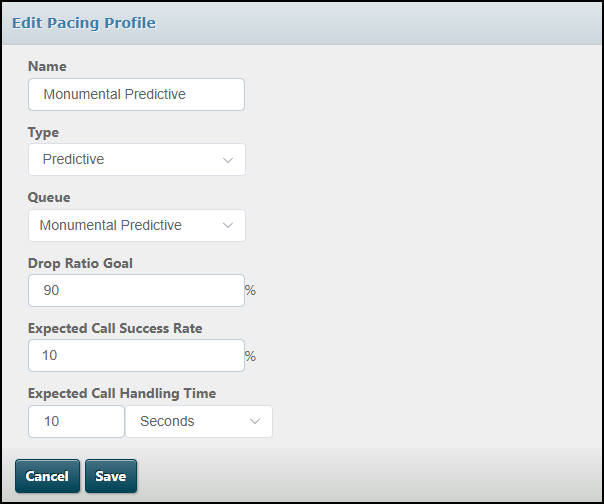
The expected call success rate and expected handling time are used if the environment or available data is not considered sufficient or appropriate to support predictive dialling.
|
Field |
Description |
|
Drop Ratio Goal |
The maximum number of abandoned calls that is to be tolerated, as a percentage. |
|
Expected Call Success Rate |
The proportion of calls that will result in a successful contact, as a percentage. A successful call is one where the call connects (but is not necessarily routed to an agent), and does not get flagged as answer machine, through the optional use of the AMD cell in FLOW. |
|
Expected Call Handling Time |
The expected call handling time in either seconds or minutes. This relates to those calls which successfully connect, and then route on to an agent. It is the total handling time, taken as the sum of the call duration + wrap duration (if there is one). |
UC and CONTACT Configuration Settings
When configuring a predictive OUTBOUND campaign, it is important to ensure the following:
- The queue must be specified as a queue for a predictive campaign
- Any agents associated with a predictive queue must not be associated with any other queue.
Testing a Predictive Dial Campaign
When testing a new predictive dial campaign, it may be necessary to adjust the expected call success rate and drop ratio goal rate.
If the records in DATA MANAGEMENT are being processed, but are not actively being dialled, it suggests that the pacing decision is not to make calls. If there is only one active agent for the campaign, it will be necessary to adjust the pacing profile to make the Expected Call Success rate very low (1%), and the Drop Ratio Goal rate very high (99%).